
 A successful donor wall should do more than place names on a wall.
It should become part of the environment.
It should complement the architecture, reflect the organization’s identity, express gratitude in a meaningful way, and — when possible — provide enough flexibility to evolve as new donors become part of the story.
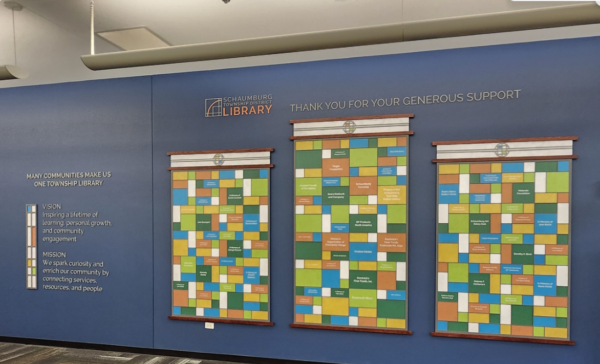
The custom donor recognition wall designed for the Schaumburg Township District Library accomplishes all of these goals through a distinctive Prairie-style design inspired by the architectural principles associated with Frank Lloyd Wright.
Rather than creating a conventional grid of plaques, Friedman Fine Art developed a donor wall installation that visually connects with the architecture and interior character of the library while providing an innovative system for adding donor names over time.
The result is a colorful, architectural and highly functional recognition display that celebrates both philanthropy and community.
A Donor Wall Designed to Belong in the Library
One of the most important considerations when designing a donor recognition wall is understanding the physical environment in which it will live.
A donor display should never feel as though it was selected from a catalog and simply attached to an available wall.
For the Schaumburg Township District Library, the desired aesthetic was influenced by Prairie-style architecture, a design vocabulary famously developed and refined by Frank Lloyd Wright.
Prairie-style design is associated with strong horizontal lines, geometric patterns, natural materials, carefully balanced proportions and an architectural relationship between individual decorative elements and the larger structure.
Those characteristics became an important source of inspiration for the donor wall.
The three primary recognition panels feature strong horizontal wooden trim, symmetrical architectural framing and geometric fields of colored rectangles. The resulting composition feels almost like a series of architectural windows or decorative art-glass panels.
That visual approach works especially well in a library environment because it creates a sense of permanence, craftsmanship and order without becoming formal or institutional.
The donor wall feels like part of the building.
That is one of the fundamental principles behind great custom donor wall design: the recognition display should support the surrounding architecture rather than compete with it.
For organizations considering their own project, our article on creative donor wall ideas and recognition displays explores additional ways donor recognition can be integrated into an organization’s physical environment.
Turning Prairie-Style Geometry Into Donor Recognition
The center of the installation is composed of three large architectural panels filled with differently sized rectangular elements.
These individual blocks create an intricate visual mosaic.
Some contain donor names.
Others remain intentionally graphic.
The variation in color, size and placement prevents the donor wall from looking like a traditional list.
Instead, every name becomes part of a larger composition.
This is an important distinction.
A donor recognition wall has two jobs:
- Recognize the people and organizations whose generosity deserves acknowledgment.
- Create a visually compelling installation that enhances the space.
When these goals are treated separately, the result often looks like signage.
When they are designed together, the donor wall becomes art.
The Schaumburg Township District Library project demonstrates how individual donor recognition elements can become part of an overall pattern rather than appearing as isolated plaques.
The colored rectangles create movement across the panels while still maintaining enough structure and repetition to keep the display visually organized.
An Expandable Donor Wall Designed for Future Names
One of the smartest functional features of this donor wall is something visitors may never immediately notice.
The donor recognition system was designed so that additional donor names could be added without rebuilding the entire display.
The concept was straightforward and practical.
When a new donor needed to be recognized, a piece of vinyl matching the color of the appropriate rectangular segment could be produced with the donor’s name and applied directly to that section.
This allowed the library to preserve the original visual composition while continually updating the display.
Instead of replacing acrylic plaques, drilling new mounting holes or redesigning entire sections of the donor wall, the recognition system could grow within the existing framework.
That flexibility is enormously valuable for nonprofit organizations and educational institutions.
Many donor walls are installed following a capital campaign, building renovation, fundraising initiative or major anniversary. But fundraising rarely stops when the wall is completed.
New gifts arrive.
New campaigns begin.
New families become involved.
Organizations grow.
A donor recognition system should anticipate that reality.
The Schaumburg Township District Library installation provides a good example of what might be called a living donor wall — a recognition display created with future growth already built into the design.
This same philosophy appears in other Friedman Fine Art projects. For example, the Latin School of Chicago donor wall incorporates hundreds of acrylic tiles and was specifically designed so that additional donor names could be incorporated for years to come.
Donor Recognition Without Sacrificing Visual Balance
Designing an expandable donor wall creates an interesting challenge.
How do you leave room for future donors without making the wall look unfinished today?
Simply leaving large blank areas usually does not work.
Visitors immediately recognize those spaces as missing information.
The Schaumburg Township District Library design addresses this elegantly.
The colored geometric pieces function visually whether or not they contain donor names.
A rectangle without a donor name still looks like part of the Prairie-inspired design.
When a name is added later, that same rectangle becomes a donor recognition element.
The architecture of the display does not change.
This is an excellent example of designing future capacity into the artwork itself.
The concept is similar to another expandable recognition project Friedman Fine Art developed for the Latin School of Chicago, where blank acrylic tiles were deliberately integrated throughout the original composition so future names could be added without disrupting the balance of the display.
For organizations that anticipate continued fundraising, this kind of planning can greatly extend the useful life of a donor wall.
Giving Levels Can Become Part of the Design
Another advantage of using different sizes and colors is the ability to visually differentiate donor recognition levels.
Many fundraising campaigns include several giving categories.
For example:
- Leadership donors
- Major gifts
- Corporate sponsors
- Family gifts
- Memorial gifts
- Community supporters
- Founding donors
A custom donor recognition wall can communicate these distinctions without turning the display into a chart.
Larger blocks can represent larger giving levels.
Different colors can distinguish categories.
Placement can indicate hierarchy.
Typography can create additional emphasis.
The exact system depends on the organization, fundraising structure and desired level of transparency.
In some installations, donation amounts are explicitly shown.
In others, different sizes or colors recognize levels without publishing specific dollar values.
The Chiaravalle Montessori donor wall provides another example of this approach. That installation uses differently sized and colored acrylic circles inspired by the school’s branding, with the visual hierarchy helping distinguish levels of giving while preserving the overall artistic composition.
Incorporating the Library’s Vision and Mission
The Schaumburg Township District Library donor wall does something else particularly well.
It explains why the donors matter.
Positioned beside the donor recognition panels are the library’s Vision and Mission statements.
The Vision reads:
Inspiring a lifetime of learning, personal growth, and community engagement.
The Mission emphasizes curiosity, enrichment and connecting the community with services, resources and people.
Placing these statements next to the donor wall connects philanthropy directly with purpose.
That connection is extremely important.
A donor recognition display should never communicate only:
These people gave money.
It should communicate:
These people helped make this mission possible.
That small shift changes the emotional meaning of the installation.
Visitors see the names.
Then they see the purpose those donors support.
The recognition wall becomes a statement about shared values rather than simply financial contribution.
“Many Communities Make Us One Township Library”
Another meaningful component of the installation is the phrase:
MANY COMMUNITIES MAKE US
ONE TOWNSHIP LIBRARY
This message gives the donor wall an additional layer of meaning.
A public library belongs to many constituencies.
Families.
Students.
Children.
Teachers.
Businesses.
Community organizations.
Longtime residents.
New residents.
Donors.
Volunteers.
Staff members.
The visual diversity of the donor panels reflects that idea surprisingly well.
Different colors.
Different dimensions.
Different names.
Different organizations.
Yet all of the elements come together to form one unified composition.
That visual metaphor supports the library’s message about community particularly effectively.
The donor wall becomes not only a recognition display but a representation of the community itself.
Donor Walls as Environmental Storytelling
Modern donor walls increasingly function as part of a broader category of environmental storytelling.
Instead of separating branding, institutional history, mission statements and donor recognition into unrelated signs, organizations can combine these elements into a unified visual experience.
A visitor walking past the Schaumburg Township District Library donor wall encounters several pieces of information almost simultaneously:
- The identity of the library
- A message of gratitude
- The names of supporters
- The organization’s mission
- Its vision for the community
- An architectural design that reflects the building
That is far more powerful than a traditional plaque.
The wall explains who helped the library.
It explains what the library believes.
And it visually communicates the importance of community.
This same storytelling principle can also be applied to organizational history. Our article How History Timeline Walls Strengthen Donor Relationships in Non-Profit Organizations discusses how history displays can help donors understand an organization’s longevity, growth and impact.
Why Architecture Matters in Donor Wall Design
One of the easiest mistakes to make when planning a donor wall is designing the display before properly considering the building.
The architecture should influence decisions such as:
- Overall dimensions
- Shape
- Materials
- Colors
- Typography
- Lighting
- Mounting techniques
- Viewing distance
- Traffic patterns
- Available expansion space
A contemporary glass lobby may call for transparent acrylic, stainless steel or suspended panels.
A historic institution may benefit from wood, bronze or traditional dimensional lettering.
A school may incorporate playful shapes and bold colors.
A medical facility may require a calmer, more refined visual language.
And a building influenced by Prairie architecture may benefit from geometric compositions, horizontal details and warm wood accents.
The Schaumburg Township District Library project demonstrates how architectural compatibility can dramatically improve the finished result.
Rather than fighting the space, the donor wall reinforces it.
Custom Donor Walls Versus Generic Plaque Systems
Organizations planning a donor recognition program frequently begin by looking at standard plaque systems.
That approach can work for some spaces.
But custom donor walls provide opportunities that premanufactured plaques simply cannot.
A custom recognition display can incorporate:
- Organizational colors
- Logos
- Mission statements
- Campaign messaging
- Historic photographs
- Architectural references
- Custom typography
- Dimensional lettering
- Acrylic or glass panels
- Magnetic donor elements
- Changeable donor plaques
- Wallcoverings
- Murals
- Digital graphics
- Modular expansion systems
Most importantly, the display can be created specifically around the organization.
That is why some of the most effective donor walls feel less like signage and more like permanent architectural installations.
The broader evolution of donor recognition is discussed in The Evolution of Donor Walls and Company Timeline Walls, which looks at how donor walls have progressed from relatively simple recognition systems into sophisticated storytelling environments.
A Donor Wall Should Encourage Future Giving
Donor recognition has an obvious purpose: thanking existing supporters.
But thoughtfully designed donor walls can accomplish something else.
They can encourage future philanthropy.
Visitors naturally read donor walls.
They recognize family names.
They recognize local businesses.
They recognize foundations and organizations.
They begin to understand how much community support helped create or sustain the institution.
And sometimes they imagine their own name becoming part of that story.
That does not require an aggressive fundraising message.
The recognition itself becomes a subtle invitation.
It demonstrates that generosity is remembered.
It demonstrates that donors become part of the organization’s legacy.
The article A Strategic Approach to Donor Walls: Turning Recognition into Inspiration explores this idea in greater depth, including how effective donor recognition can reinforce institutional values and inspire continued philanthropic participation.
Designing Donor Walls for Libraries, Schools and Community Institutions
Libraries are especially interesting environments for donor recognition because their missions are inherently community-oriented.
The same is true for:
- Public libraries
- Universities
- Private schools
- Museums
- Cultural organizations
- Community centers
- Hospitals
- Religious organizations
- Foundations
- Social service organizations
These institutions often depend heavily upon relationships built over decades.
Their donor walls therefore have an opportunity to communicate much more than financial support.
They can express belonging.
They can communicate history.
They can celebrate institutional values.
They can recognize generations of supporters.
And they can help visitors understand how philanthropy becomes tangible community impact.
For another educational example, see our feature on the Latin School of Chicago donor recognition wall, where planning for future donors was incorporated into the original design.
Practical Lessons From the Schaumburg Township District Library Donor Wall
This installation offers several useful lessons for organizations planning a recognition display.
Design for the building.
The Prairie-style architectural influence helps the donor wall feel permanent and intentional.
Design for future donors.
The vinyl name system allows new recognition to be incorporated without reconstructing the display.
Make unused recognition spaces attractive.
Colored geometric segments remain part of the composition even before donor names are added.
Connect philanthropy to mission.
The vision and mission statements explain what donor generosity helps accomplish.
Make donor recognition part of the story.
The installation communicates community, gratitude and organizational identity simultaneously.
Avoid the “plaque board” mentality.
A donor wall can be architecture, graphic design, storytelling and recognition at the same time.
A Living Recognition Wall for a Living Institution
Perhaps the best feature of the Schaumburg Township District Library donor wall is that it was not designed as a finished monument.
It was designed as a framework.
The architectural structure remains constant.
The Prairie-inspired composition remains constant.
The library’s mission remains central.
But donor recognition can continue to evolve.
New names can become part of the display.
New supporters can become part of the community story.
That is exactly what an effective donor wall should accomplish.
It recognizes the generosity that helped build the institution while leaving room for the people who will help carry its mission forward.
Create a Custom Donor Wall for Your Organization
Every organization has a different story.
Every building has a different architectural character.
Every fundraising campaign has different recognition requirements.
Friedman Fine Art works with libraries, schools, universities, nonprofit organizations, healthcare institutions, corporations, religious organizations and community groups to create custom donor walls, donor recognition displays, history walls and timeline installations designed specifically for their environments.
Whether your organization needs an expandable donor wall, dimensional donor plaques, acrylic recognition panels, magnetic donor elements, graphics, photography, architectural lettering or a completely custom recognition concept, the goal is the same:
Create a donor wall that honors generosity while becoming a meaningful part of your organization.
Explore more donor wall projects and ideas or view our custom donor wall design services.
Ready to create a donor recognition wall for your organization?
Contact Friedman Fine Art to discuss your space, fundraising campaign, architectural environment and future donor-recognition needs.