
A well-designed history wall can turn an organization’s past into a daily source of identity, pride, and connection.

Acrylic panels over seamless wall covering with dimensional letters
The Joint Commission history wall uses acrylic panels, seamless wall covering, dimensional lettering, and decades of milestones to create a highly visible corporate storytelling experience. Photo: Friedman Fine Art.
Company culture is not created by mission statements alone. It grows from shared values, meaningful experiences, traditions, people, and a collective understanding of where an organization has been and where it is going. As companies look for stronger ways to engage employees and make workplaces feel more purposeful, history walls have become an increasingly valuable culture-building tool.
A thoughtfully designed history wall brings an organization’s story into the physical environment. Founding moments, important milestones, innovations, photographs, employee achievements, leadership stories, products, community impact, and defining turning points can all become part of a visual narrative employees encounter every day. The result is more than decoration: it is an environment that helps people understand the organization they belong to.
For a broader look at the role these installations play in corporate interiors, see Why Companies Are Investing in History Walls.
Connecting Employees to the Company’s Story
Many employees understand what a company does today but know surprisingly little about how it reached that point. They may not know the problems the founders were trying to solve, the risks taken during periods of growth, the products or services that changed the business, or the people whose decisions shaped the organization.
A history wall makes that story visible. Instead of asking employees to search through an archive, annual report, or old website, the organization places its history directly in the workplace. A clear timeline can show how a modest beginning developed into new facilities, expanded markets, major innovations, acquisitions, community partnerships, or decades of service.
That context matters because employees can see themselves as part of a continuing story rather than simply occupants of a present-day organization. The message becomes: people before you helped build this, your work contributes to it now, and future chapters are still being written.

Large fabric covered acrylic panels with dimensional letters
Rand-Whitney Containerboard: large fabric-covered acrylic panels with dimensional lettering create an easy-to-follow corporate timeline. Photo: Friedman Fine Art.
Reinforcing Core Values Through Real Examples
Values are more persuasive when employees can see evidence of them. A wall that simply says “innovation,” “service,” or “teamwork” may communicate a message, but a history wall can show when those values actually mattered.
For example, a company can highlight a breakthrough product that required years of experimentation, a period when employees worked together to overcome a major challenge, a community initiative that grew into a long-term commitment, or a customer-service decision that became part of the company’s reputation. These stories connect abstract values to real events.
When those examples are integrated into the workplace using brand colors, typography, archival photographs, quotations, and dimensional graphics, the culture becomes visible rather than merely stated.
This approach is closely related to the ideas explored in Corporate History Wall Design Trends, where storytelling, brand integration, mixed media, and interactive elements are increasingly shaping modern history displays.
Celebrating Achievements and Milestones
Organizations move quickly. A major product launch, facility opening, industry award, acquisition, anniversary, record-setting project, or new market may feel important when it happens, yet years later the significance can fade from everyday memory.
History walls preserve those moments and give employees a reason to take pride in the organization’s progress. Milestones demonstrate that growth did not happen automatically; it was produced by ideas, persistence, teamwork, leadership, and often a willingness to change.
Milestone-based timelines also make company growth easier to understand at a glance. They are especially effective in lobbies, corridors, conference areas, visitor centers, and employee gathering spaces where people can naturally pause and explore.
For design approaches ranging from milestone-based timelines to employee-centered and mixed-media displays, visit Best Timeline Wall Ideas for Corporate Offices.
Recognizing the People Behind the Success
Successful organizations are built by people, and the strongest corporate stories make that human contribution visible. Founders and executives may be part of the story, but so are long-term employees, project teams, engineers, designers, salespeople, craftspeople, volunteers, educators, clinicians, and others whose work shaped the organization.
Photographs, employee quotations, workforce milestones, leadership stories, team accomplishments, and moments of collaboration can help a history wall feel personal rather than institutional. Employees are more likely to connect with a story when they can see the people who lived it.
Recognition also sends a cultural message: individual contributions matter. The organization did not become successful through a logo or a building; it grew because people contributed their skills, ideas, time, and energy.
That people-first approach is explored further in Employee-Centered History Displays, which looks at using employee achievements, leadership stories, and workforce milestones as part of corporate history walls.
Supporting Employee Engagement and Onboarding
A history wall can also function as an informal onboarding resource. New employees often receive a large amount of information in their first days and weeks, but a visual timeline gives them an immediate sense of the organization’s identity and continuity.
Managers can incorporate the wall into orientation tours, leadership presentations, recruiting visits, anniversary events, and employee recognition programs. A display that was designed primarily for a lobby can therefore become an ongoing communication asset.
For established employees, the wall creates recurring opportunities for conversation. A historic photograph may prompt someone to share a story. A milestone may remind a department how a current process evolved. An anniversary may inspire employees to reflect on what the organization should accomplish next.
Strengthening Brand Identity Inside the Workplace
Corporate branding is often aimed outward at customers and prospects, but employees experience the brand from the inside. A history wall can connect visual identity with organizational substance by combining the company’s colors, typography, logo, imagery, mission, products, achievements, and heritage in one cohesive environment.
This is particularly valuable in renovated offices, new headquarters, merged organizations, or rapidly growing companies where employees may need a stronger sense of continuity. A well-integrated history wall can help a space feel unmistakably connected to the organization rather than like a generic office.
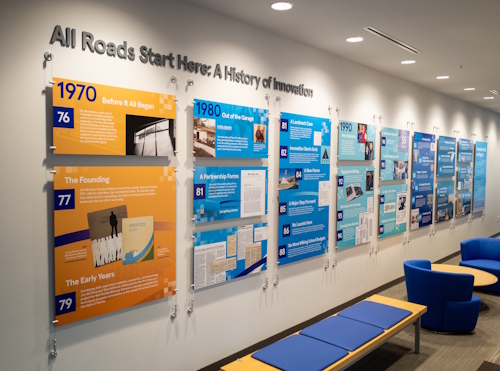
Infotech history timeline wall: suspended acrylic panels turn a long corridor into an engaging visual story of innovation and organizational growth. Photo: Friedman Fine Art.
Creating a Shared Experience for Employees and Visitors
Company culture is experienced not only by employees but also by clients, prospective hires, business partners, donors, board members, and community visitors. A strong history display provides all of these audiences with a consistent story about the organization.
For employees, it can reinforce belonging. For prospective employees, it can communicate stability and purpose. For clients, it can demonstrate experience and credibility. For leadership, it becomes a visible reminder that today’s decisions will eventually become part of the organization’s history.
The Joint Commission history wall project is a strong example of how architecture, historical content, photographs, dimensional elements, and chronological storytelling can work together to create a destination within the workplace.
Designing a History Wall That Can Grow With the Company
The best history walls are not designed as closed stories. Organizations continue to grow, and the display should be able to grow with them. Future expansion can be planned through modular acrylic panels, replaceable graphics, magnetic or interchangeable components, suspended panel systems, or intentionally reserved space for new milestones.
Content should also be curated carefully. A history wall does not need to include every date or event. The goal is to select the moments that best explain how the organization became what it is today. A balanced mix of concise text, photographs, artifacts, quotations, products, graphics, and dimensional elements usually creates a stronger experience than dense blocks of copy.
For a detailed look at planning content, location, materials, visual flow, readability, brand integration, and future expansion, read Designing a Custom Company History Timeline Wall.
A Stronger Workplace Begins With a Story People Can See
History walls are more than decorative displays. They are storytelling tools that preserve organizational heritage while making culture tangible in the workplace. By connecting employees to the company’s journey, reinforcing values, celebrating achievements, recognizing people, and creating a shared sense of identity, a history wall can help transform corporate history into an active part of company culture.
The most effective installations do not simply look backward. They connect the past to the present and create a visual invitation to consider what comes next. That is what makes a well-designed history wall so powerful: it reminds employees that the organization’s story is still being written.
| Bring Your Organization’s Story to Life
Friedman Fine Art has been developing corporate and institutional art and graphic programs for more than 40 years, including custom history walls, timeline displays, donor recognition walls, and environmental graphics. Each project is developed collaboratively to reflect the organization’s history, architecture, brand, culture, and goals. Explore History Wall examples or contact Friedman Fine Art to discuss a custom history wall for your organization. Chicago, Illinois 60611 • 312.545.6360 • info@friedmanfineart.net |